
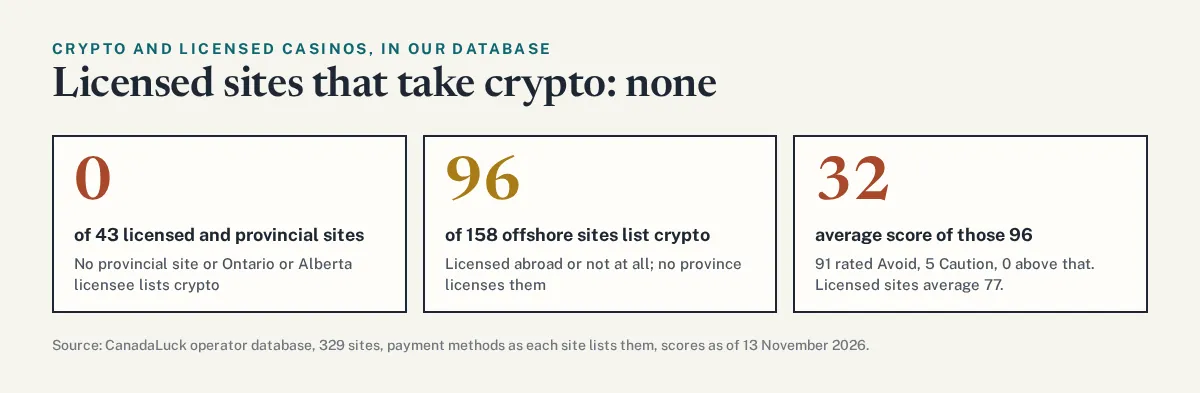
No legal Canadian casino takes crypto. Ontario’s AGCO Standard 5.69 and Alberta’s AGLC standards both say cryptocurrency is not legal tender and must not be accepted, and no provincial site lists it. Every crypto casino open to Canadians is offshore. We do not recommend any of them; this page explains why and shows the legal sites in your province.
- Licensed sites taking crypto
- 0of 43 licensed and provincial sites
- Offshore sites listing crypto
- 96of 158 offshore sites we track
- Their average score
- 32/10091 rated Avoid
- Minimum age
- 19+And physically in the province

Elliot Marsh, lead reviewer (pen name)
Checked against operators' own pages and provincial registries. No paid placements.
Crypto casinos are easy to find and many say they welcome Canadians. They accept bitcoin, ether, tether and other coins, often with little identity checking at sign-up. What they do not have is a licence from a Canadian province. That is not a technicality: it decides who you can complain to if a withdrawal is refused, whether self-exclusion works, and whether anyone in Canada can make the site pay. Here is what our database shows.
Crypto at licensed sites: the numbers
Licence as each site states it, checked against public registries where they exist. None of these licences is issued by a Canadian province.
Average score 32/100. For comparison, the 43 licensed and provincial sites we track: 0 take crypto. Database of 329 sites.
None of the licences behind these sites is issued by a Canadian province. Kahnawake is a First Nation regulator in Quebec, but its licences are not provincial licences under the Criminal Code; our Kahnawake guide explains the difference.
Why legal sites will not take crypto
In Ontario, Standard 5.69 allows deposits only after verification and authorization by a financial services provider, and adds: cryptocurrency is not legal tender and shall not be accepted. Alberta’s standards for internet gaming, issued on 14 January 2026, carry the same note. Provincial sites such as OLG.ca and Play Alberta list their payment methods, and crypto is not among them; OLG’s player agreement says no other payment methods are permitted.
The reasons are practical. A regulated site has to know who is paying, return money to an account in the player’s name and handle disputes in dollars. Crypto makes all three harder. Federal law does have a FINTRAC report for casinos that receive $10,000 or more in virtual currency, but that is a reporting rule, not permission: provincial standards still forbid crypto deposits at licensed online sites.
Legal casinos in your province
If you want to play legally, these are your options. The last column confirms what each site does with crypto, with the rule or page behind it.
| # | Site | Score | Crypto deposits | Link |
|---|---|---|---|---|
| 1 |  BetMGM CasinoLicensed in Ontario and Alberta | 89 Recommended | No. Banned in Ontario (AGCO 5.69) and Alberta (AGLC) source, 13 Nov | Visit |
| 2 |  OLGProvincial site (ON) | 88 Recommended | No. Only listed methods permitted source, 13 Nov | Visit |
| 3 |  DraftKings SportsbookLicensed in Ontario and Alberta | 86 Recommended | No. Banned in Ontario (AGCO 5.69) and Alberta (AGLC) source, 13 Nov | Visit |
| 4 |  FanDuel SportsbookLicensed in Ontario and Alberta | 86 Recommended | No. Banned in Ontario (AGCO 5.69) and Alberta (AGLC) source, 13 Nov | Visit |
| 5 |  Stardust CasinoLicensed in Ontario and Alberta | 85 Recommended | No. Banned in Ontario (AGCO 5.69) and Alberta (AGLC) source, 13 Nov | Visit |
| 6 |  BetiniaLicensed in Ontario | 83 Recommended | No. Banned by AGCO standard 5.69 source, 13 Nov | Visit |
| 7 |  Royal Vegas CasinoLicensed in Ontario and Alberta | 83 Recommended | No. Banned in Ontario (AGCO 5.69) and Alberta (AGLC) source, 13 Nov | Visit |
| 8 |  TonyBetLicensed in Ontario and Alberta | 83 Recommended | No. Banned in Ontario (AGCO 5.69) and Alberta (AGLC) source, 13 Nov | Visit |
 Espacejeux (Loto-Quebec)Provincial site (QC) | 82 Recommended | Not stated | Visit | |
| 9 |  Jackpot CityLicensed in Ontario and Alberta | 82 Recommended | No. Banned in Ontario (AGCO 5.69) and Alberta (AGLC) source, 13 Nov | Visit |
| 10 |  KnightSlotsLicensed in Ontario | 82 Recommended | No. Banned by AGCO standard 5.69 source, 13 Nov | Visit |
 PlayNowProvincial site (BC, MB, SK) | 82 Recommended | Not stated | Visit | |
| 11 |  PlayOJOLicensed in Ontario and Alberta | 82 Recommended | No. Banned in Ontario (AGCO 5.69) and Alberta (AGLC) source, 13 Nov | Visit |
 Atlantic Lottery (ALC)Provincial site (NB, NS, PE, NL) | 81 Recommended | Not stated | Visit | |
| 12 |  NorthStar BetsLicensed in Ontario | 81 Recommended | No. Banned by AGCO standard 5.69 source, 13 Nov | Visit |
| 13 |  SpinGenieLicensed in Ontario and Alberta | 81 Recommended | No. Banned in Ontario (AGCO 5.69) and Alberta (AGLC) source, 13 Nov | Visit |
| 14 |  Mr VegasLicensed in Ontario | 80 Recommended | No. Banned in Ontario (AGCO 5.69) and Alberta (AGLC) source, 13 Nov | Visit |
| 15 |  SlotsMagicLicensed in Ontario and Alberta | 80 Recommended | No. Banned in Ontario (AGCO 5.69) and Alberta (AGLC) source, 13 Nov | Visit |
| 16 |  Golden Nugget CasinoLicensed in Ontario and Alberta | 79 Acceptable | No. Banned in Ontario (AGCO 5.69) and Alberta (AGLC) source, 13 Nov | Visit |
 Play AlbertaProvincial site (AB) | 79 Acceptable | No. Not among accepted methods source, 13 Nov | Visit | |
| 17 |  BET99Licensed in Ontario and Alberta | 78 Acceptable | No. Banned in Ontario (AGCO 5.69) and Alberta (AGLC) source, 13 Nov | Visit |
| 18 |  BetVictorLicensed in Ontario and Alberta | 78 Acceptable | No. Banned in Ontario (AGCO 5.69) and Alberta (AGLC) source, 13 Nov | Visit |
| 19 |  Casino TimeLicensed in Ontario and Alberta | 78 Acceptable | No. Banned in Ontario (AGCO 5.69) and Alberta (AGLC) source, 13 Nov | Visit |
| 20 |  LeoVegasLicensed in Ontario | 78 Acceptable | No. Banned by AGCO standard 5.69 source, 13 Nov | Visit |
| 21 |  Sports InteractionLicensed in Ontario and Alberta | 78 Acceptable | No. Banned in Ontario (AGCO 5.69) and Alberta (AGLC) source, 13 Nov | Visit |
| 22 |  bet365Licensed in Ontario and Alberta | 78 Acceptable | No. Banned in Ontario (AGCO 5.69) and Alberta (AGLC) source, 13 Nov | Visit |
| 23 |  Play FallsviewLicensed in Ontario | 76 Acceptable | No. Banned by AGCO standard 5.69 source, 13 Nov | Visit |
| 24 |  BettyLicensed in Ontario and Alberta | 75 Acceptable | No. Banned in Ontario (AGCO 5.69) and Alberta (AGLC) source, 13 Nov | Visit |
| 25 |  Captain Cooks CasinoLicensed in Ontario and Alberta | 75 Acceptable | No. Banned in Ontario (AGCO 5.69) and Alberta (AGLC) source, 13 Nov | Visit |
| 26 |  Casino ClassicLicensed in Ontario and Alberta | 75 Acceptable | No. Banned by AGCO standard 5.69 source, 13 Nov | Visit |
| 27 |  Casino DaysLicensed in Ontario and Alberta | 75 Acceptable | No. Banned in Ontario (AGCO 5.69) and Alberta (AGLC) source, 13 Nov | Visit |
| 28 |  Lucky DaysLicensed in Ontario and Alberta | 75 Acceptable | No. Banned in Ontario (AGCO 5.69) and Alberta (AGLC) source, 13 Nov | Visit |
| 29 |  Spin AwayLicensed in Ontario | 75 Acceptable | No. Banned by AGCO standard 5.69 source, 13 Nov | Visit |
| 30 |  Delta Bingo (Delta Casino online)Licensed in Ontario and Alberta | 73 Acceptable | No. Banned by AGCO standard 5.69 source, 13 Nov | Visit |
| 31 |  ToppzLicensed in Ontario | 73 Acceptable | No. Banned by AGCO standard 5.69 source, 13 Nov | Visit |
| 32 |  Neo.betLicensed in Ontario | 72 Acceptable | No. Banned by AGCO standard 5.69 source, 13 Nov | Visit |
| 33 |  BetRiversLicensed in Ontario and Alberta | 69 Acceptable | No. Banned in Ontario (AGCO 5.69) and Alberta (AGLC) source, 13 Nov | Visit |
| 34 |  Fever SlotsLicensed in Ontario | 67 Acceptable | No. Banned by AGCO standard 5.69 source, 13 Nov | Visit |
 LuckyLinerLicensed in Alberta | 59 Caution | No. Banned by AGLC standards, s. 4 source, 13 Nov | Visit |
No online casino is licensed or run by this province or territory. What is legal here
Scores from our reports; licence status from provincial registries. Facts in the last columns come from each operator's own help, terms or cashier pages, read on 13 November 2026. "Not stated" means we did not find it on an official page, not that it does not exist. The cashier after sign-up is the final word.
The real risks of crypto casinos
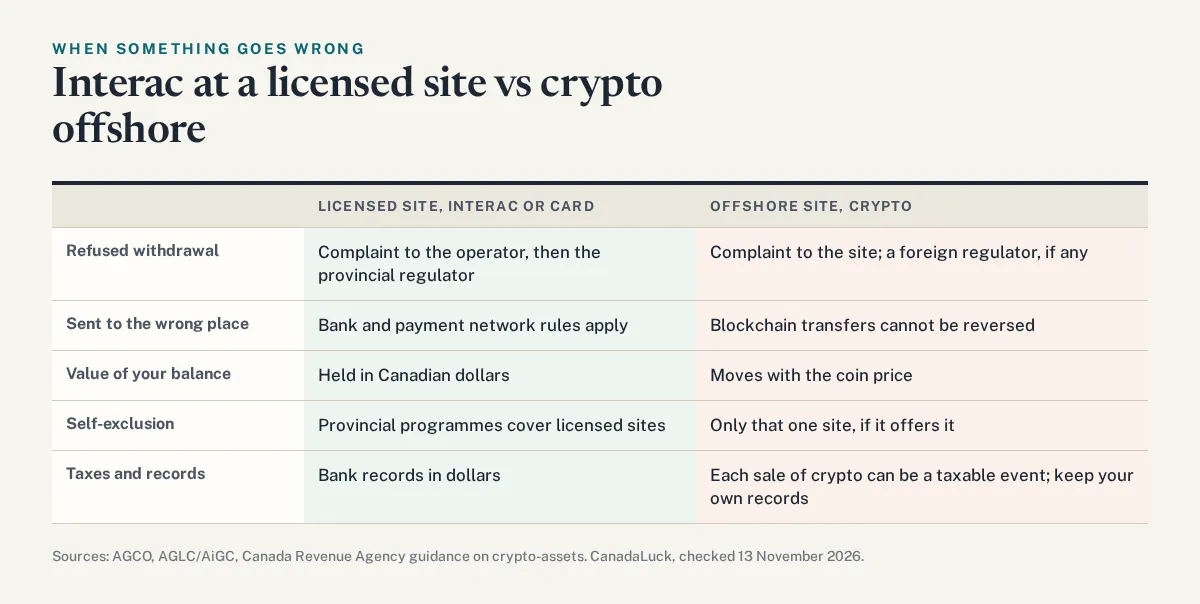
- No provincial regulatorIf a withdrawal is refused, you can complain to the site or a foreign regulator, if there is one. No Canadian body can order a payout.
- Transfers cannot be reversedA coin sent to the wrong address, or to a site that disappears, is gone. There is no chargeback.
- Your balance moves with the coinIf the site holds coins, the value of your balance changes every minute, whether you play or not.
- Self-exclusion does not reach themProvincial programmes cover licensed sites only. An offshore site's own exclusion covers that one site.
- KYC still happensMany crypto casinos ask for ID at the first large withdrawal, which can freeze funds you thought were free to leave.
The price math nobody shows you
A crypto deposit has costs before you place a bet. You buy coins at an exchange, usually with a spread or fee. You pay a network fee to send them. When you cash out, you pay the network fee again, then the spread again to sell, and in between the coin price moves. The chart uses $500, a 1.5% spread each way and $10 in total network fees, with no wins or losses at the casino.
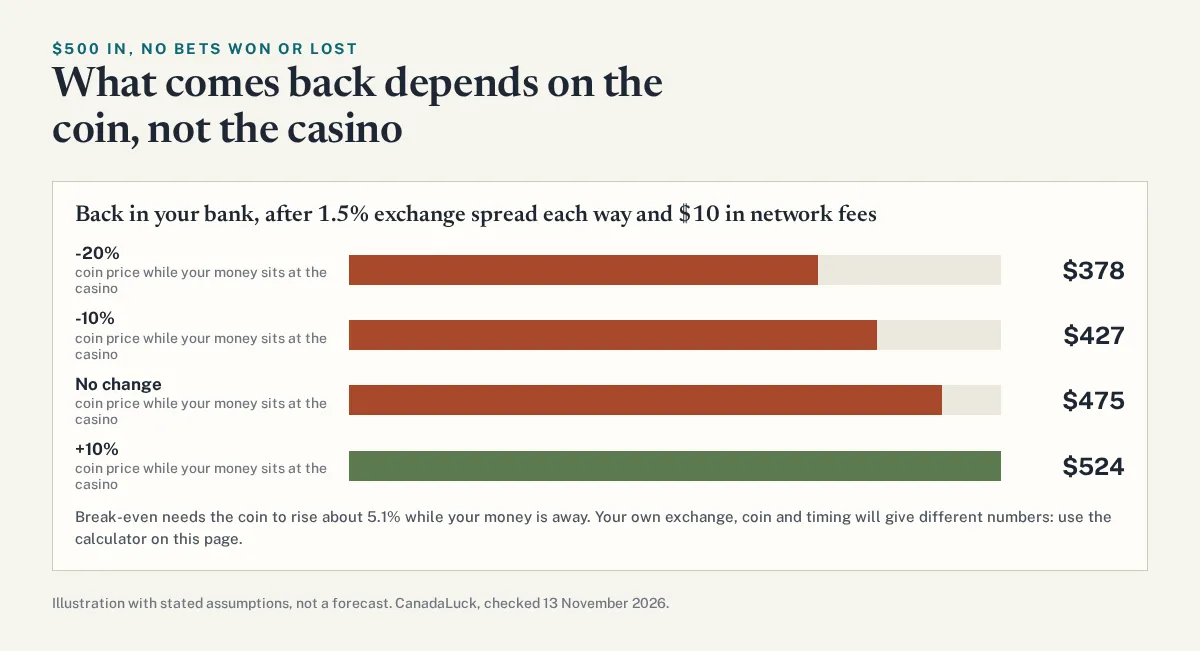
Break-even needs the coin to rise about 5% while your money is away. Your exchange, coin and timing will give different numbers, so try your own:
Crypto, casinos and tax
Recreational gambling winnings are not taxed in Canada; the Canada Revenue Agency taxes gambling only when it is carried on as a business. Crypto is different. The CRA treats crypto as a commodity, so selling or trading coins can create a capital gain or business income, separate from anything you win at a casino. Moving money through crypto to play therefore adds tax records you would not have with Interac. Our tax guide covers the gambling side.
Signs a crypto casino is a bad bet
- Licence you cannot verifyNo licence number, or a number that is not in the regulator's public register.
- Withdrawal capsWeekly or monthly maximums that would take months to pay a large win.
- Bonus locksWithdrawals blocked until a bonus with heavy wagering is cleared, even on your own deposit.
- Changing domainsA site that moves between web addresses, often to avoid blocks.
- No real companyNo company name, address or terms that say which law applies.
If you already hold coins and want to gamble, the legal route is to sell them at a Canadian exchange, move the dollars to your bank and deposit at a licensed site with Interac or a card. It is slower, but your balance stays in dollars and a regulator stands behind it.
If gambling is getting out of hand
Crypto casinos make it easy to deposit at any hour, in amounts that are hard to keep track of in dollars. If that sounds familiar, free help is available around the clock.
Tools every licensed site must offer
- Deposit limits for 24 hours, 7 days and a month
- Loss and time limits set at sign-up or any time
- A 24-hour wait before any limit you raise takes effect
- Self-exclusion through the site or your province
Questions readers ask
- Are crypto casinos legal in Canada?
No province licenses a crypto casino. Ontario and Alberta rules forbid licensed sites to accept crypto, so every crypto casino open to Canadians is offshore and outside provincial oversight.
- Does any licensed Canadian casino accept bitcoin?
No. AGCO Standard 5.69 in Ontario and the AGLC standards in Alberta say cryptocurrency is not legal tender and must not be accepted. Provincial sites do not list it either.
- Why do offshore casinos accept crypto?
Crypto lets them take payments without Canadian banks or payment processors, which often refuse unlicensed gambling. It also means no chargebacks for the player.
- Can I complain if a crypto casino will not pay?
Only to the site and, if it has one, its foreign regulator. No Canadian provincial regulator can order an offshore site to pay.
- Is it illegal for me to play at a crypto casino?
Canadian law targets those who run unlicensed gambling rather than players, but you give up every protection a provincial licence provides. We do not recommend it.
- Are crypto casino winnings taxed?
Recreational gambling winnings are not taxed in Canada. Selling or trading the crypto itself can create a capital gain or business income, which you must report.
- Do crypto casinos skip ID checks?
Some skip them at sign-up but ask for ID at the first large withdrawal. Funds can be frozen until you provide it.
- What is the legal alternative to a crypto casino?
Sell the coins at a Canadian exchange, move the dollars to your bank and deposit at a licensed or provincial site with Interac or a card. The list on this page shows the options in your province.
- Does self-exclusion cover crypto casinos?
No. Provincial self-exclusion covers licensed and provincial sites only. Use device-level blocking software as well if you want to block offshore sites.
- Does FINTRAC allow casinos to take crypto?
FINTRAC sets a report for casinos that receive $10,000 or more in virtual currency. That is a reporting rule, not permission; Ontario and Alberta standards still forbid crypto deposits.