
Short answer You can play casino games for real money in Canada at a site your province runs or licenses, while you are physically in that province and over its minimum age. You open an account in your own name, pass an identity and age check, deposit in Canadian dollars, and cash out to a method in your name. Offshore sites take real money too, but no province stands behind them. Checked by Elliot Marsh, lead reviewer (pen name) Real money in Ontario
| 43 licences checked against provincial registers BetMGM CasinoLicensed ON, AB89/100Visit
 OLGProvincial site88/100Visit
 DraftKings SportsbookLicensed ON, AB86/100VisitBetMGM CasinoLicensed ON, AB89/100VisitDraftKings SportsbookLicensed ON, AB86/100Visit
 FanDuel SportsbookLicensed ON, AB86/100Visit
 Espacejeux (Loto-Quebec)Provincial site82/100Visit
 Atlantic Lottery (ALC)Provincial site81/100VisitAtlantic Lottery (ALC)Provincial site81/100VisitAtlantic Lottery (ALC)Provincial site81/100VisitAtlantic Lottery (ALC)Provincial site81/100Visit

This page is about the mechanics of playing for real money legally: who you can open an account with, what the identity check asks for, how the first deposit and the first withdrawal work, and what to do when something goes wrong. If you only want to know which site scores highest where you are, the casino ranking by province answers that; here we deal with what happens after you choose.
Who you can play with for real money
Real-money casino play in Canada is legal only with a site your province runs or licenses, and only while you are physically in that province. The table shows who you open the account with in each of the 13 provinces and territories, and the card at the top of the page follows the province you pick.
| Where you are | You open the account with | Who regulates it | Age |
|---|---|---|---|
| ONOntario | A registered private operator (33 on our file) or OLG | Alcohol and Gaming Commission of Ontario (AGCO) | 19+ |
| BCBritish Columbia | PlayNow only | Independent Gambling Control Office (IGCO, which replaced GPEB on 13 April 2026) | 19+ |
| ABAlberta | A registered private operator (24 on our file) or Play Alberta | Alberta Gaming, Liquor and Cannabis (AGLC) | 18+ |
| QCQuebec | Espacejeux (Loto-Quebec) only | Loto-Quebec (operator) | 18+ |
| MBManitoba | PlayNow only | Liquor, Gaming and Cannabis Authority of Manitoba (LGCA) | 18+ |
| SKSaskatchewan | PlayNow only | Saskatchewan Liquor and Gaming Authority (SLGA) | 19+ |
| NSNova Scotia | Atlantic Lottery (ALC) only | Nova Scotia Gaming Corporation | 19+ |
| NBNew Brunswick | Atlantic Lottery (ALC) only | New Brunswick Lotteries and Gaming Corporation | 19+ |
| PEPrince Edward Island | Atlantic Lottery (ALC) only | PEI Lotteries Commission | 19+ |
| NLNewfoundland and Labrador | Atlantic Lottery (ALC) only | Department of Finance (Lotteries Act) | 19+ |
| YTYukon | No online casino; online lottery only | Yukon Lottery Commission (Lotteries Yukon) | 19+ |
| NTNorthwest Territories | No online casino; online lottery only | Department of Municipal and Community Affairs (Western Canada Lottery Program) | 18+ |
| NUNunavut | No online casino; online lottery only | Government of Nunavut | 18+ |
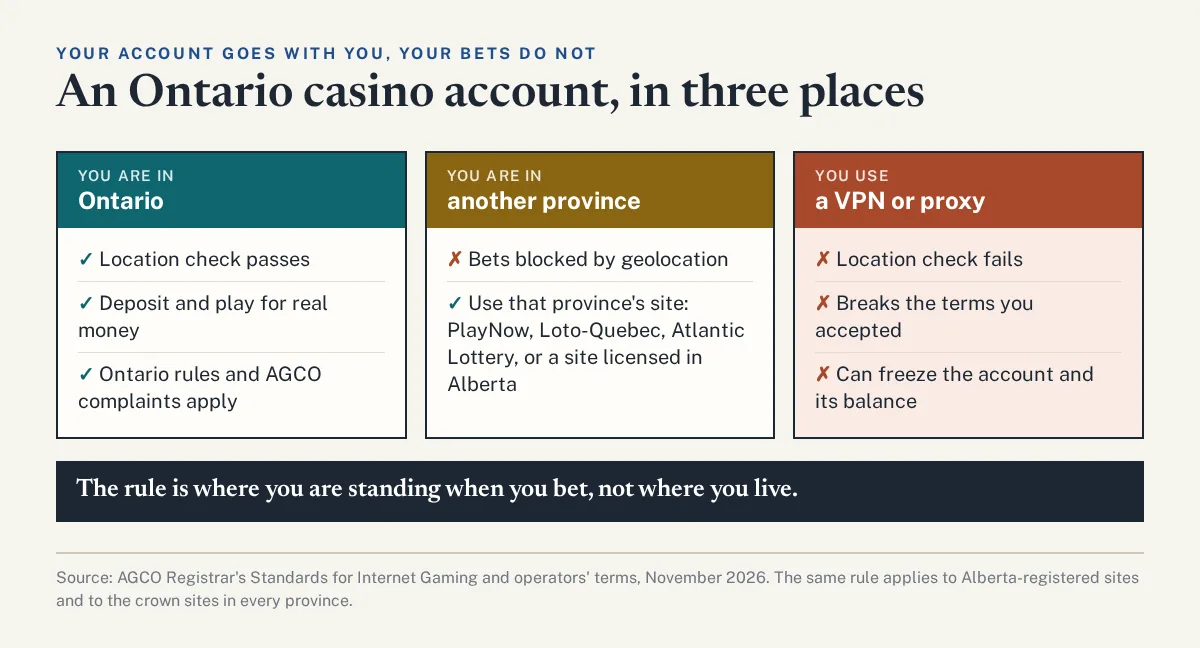
Two things surprise new players. First, location beats home address: an Ontario resident on holiday in British Columbia cannot bet on an Ontario site, and a visitor from Quebec who is in Toronto can play on an Ontario site once the checks pass. Some crown sites, such as PlayNow and Loto-Quebec, also ask for residency, so read the provincial site’s terms. Second, the same brand name can mean two different businesses. Some operators run a site registered in Ontario and a separate offshore site for the rest of Canada; only the first answers to a Canadian regulator.
Step 1: opening a real-money account
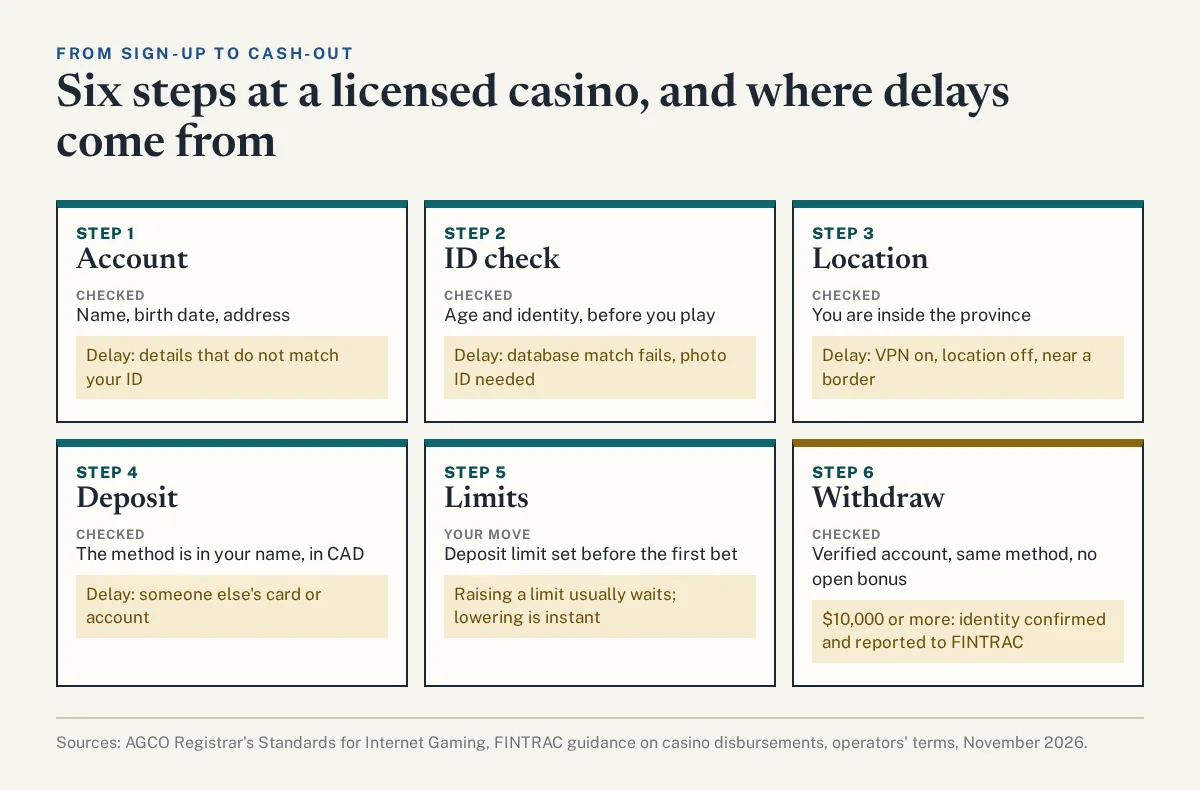
Registration asks for your legal name, date of birth, home address, email and phone number, and you choose a password and usually security questions. Use your real details. Every check that follows, from age to payment ownership to the first withdrawal, compares what you typed against official records, and a mismatch is the most common reason a payout stalls.
You may have only one account per site. Opening a second one to claim another welcome offer breaks the terms of every licensed operator and can lead to both accounts being closed. If you have excluded yourself through a provincial programme, a licensed site in that programme should refuse the registration; that is the system working, not an error.
Step 2: the identity and age check
Licensed sites must know who you are before you play. In Ontario, the AGCO’s standards require operators to confirm a player’s age before they can reach the areas where games are played, and the other provincial sites apply the same rule under their own frameworks. Most checks finish in seconds because the operator matches your name, date of birth and address against a credit bureau or another database. If that match fails, you upload a photo of government ID, and sometimes a selfie.
1
Age and identity
What they ask: Name, date of birth and address, matched against a credit bureau or other database; if that fails, a photo of government ID
When: Before you can enter the games. Ontario's standards require age checks before play.
2
Location
What they ask: Geolocation through your browser, app or device
When: Every session, and again during play. A home address in the province is not enough.
3
Payment ownership
What they ask: The card, bank account or Interac email must be in your name
When: At the first deposit, and checked again at the first withdrawal
4
Source of funds
What they ask: Proof of income or savings, only in some cases
When: When deposits or wins are large or unusual for your account
5
Large payouts
What they ask: Identity confirmed for any payout of $10,000 or more, single or within 24 hours
When: Federal anti-money-laundering rule: the casino reports it to FINTRAC
Two checks come later and only for some players. A source of funds request can follow large or unusual deposits; it is the operator’s anti-money-laundering duty, not an accusation. And under federal rules, casinos must verify the identity of anyone who receives a disbursement of $10,000 or more, in one payment or several within 24 hours, and report it to FINTRAC within 15 days. Neither check costs you anything, but both can pause a payout until you answer, so it pays to have your ID and a recent bank statement to hand.
Step 3: location checks
Before each session, and again while you play, the site checks where your device is. On a computer that means allowing location in the browser or installing a small geolocation plug-in; on a phone the app asks for location permission. A VPN or a proxy will make the check fail, and using one to get around it breaks the terms you accepted. If you live near a provincial border, expect the occasional block when your phone picks up a tower on the other side.
Step 4: the first deposit
Interac e-Transfer is the default way to fund a Canadian casino account: the money moves from your own bank, your bank sets the transfer limit and the casino sets its own minimum. Visa and Mastercard debit work at many sites. Credit cards are accepted by some, but many banks treat a gambling charge on a credit card as a cash advance, with interest from the first day. PayPal, Apple Pay and online banking appear at some of the larger operators.
Of 40 licensed casino sites, 30 publish a payment list we could read. Bars count confirmed methods; a missing bar means "not confirmed", not "not offered".
The payment method should be in your name; a deposit from a partner’s card or a shared account will hold up the first withdrawal. Keep the account in Canadian dollars. Regulated Ontario sites must show bets and payouts in Canadian currency, and the crown sites work in CAD, so there is no conversion cost. Crypto is not a licensed option: Alberta’s rules prohibit it outright, and none of the licensed casino sites on our file lists it.
Step 5: limits before the first bet
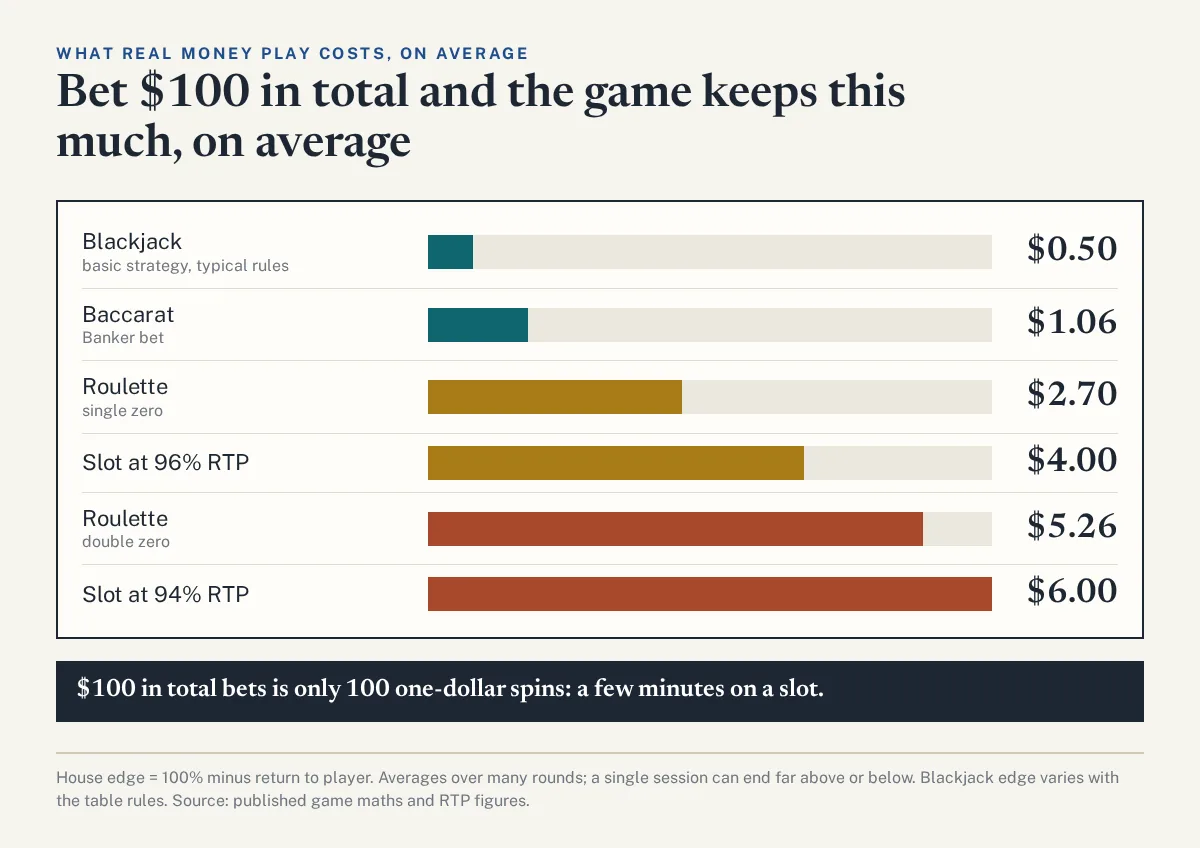
Every licensed site offers deposit limits, and most also offer loss limits, session reminders, time-outs and self-exclusion. Set the deposit limit before you play, while the decision is easy: raising a limit usually takes effect only after a waiting period, while lowering it is immediate. The planner below turns a monthly budget into a weekly deposit limit and shows what an hour of play costs on average at the game you choose.
Average cost = stake x rounds x house edge. Real sessions swing far above and below the average; this shows what the game takes over time, not what you will lose tonight.
The average is the house edge at work. It is small per bet and large over time: a slot at 96% return to player keeps four cents of every dollar wagered on average, and because you re-stake the same money many times, an hour of one-dollar spins at that game costs about twenty dollars on average. Short sessions swing well above or below that figure, which is exactly why the limit matters more than any single result.
Step 6: the first withdrawal
The first cash-out is where most delays happen, and nearly all of them come from checks that could have been done earlier. Before you request it:
- Finish verification. If the site asked for ID or proof of address, upload it before you withdraw, not after.
- Use the same method you deposited with. Many operators send money back the way it came, up to the amount deposited, to stop money laundering; anything above that goes to another method in your name.
- Check bonus status. If you took a bonus, money tied to unfinished wagering cannot be withdrawn, and cancelling the bonus may forfeit it.
- Read the minimum and processing time. The operator’s payments page should state both; if it does not, ask support before you deposit again.
After the request, the operator reviews it and then sends it; Interac and e-wallets usually arrive faster than cards or bank transfers once the operator has released the money. Our fast withdrawal guide compares what each licensed site publishes about those steps.
Before your first deposit: a checklist
Tick each line as you go. The list is stored in this browser only, so you can come back to it.
0 of 7 checked
When something goes wrong
Start with the operator: use its formal complaint process and keep the reference number it gives you. In Ontario, if you are still not satisfied after following up, you can file a complaint with the AGCO, quoting the site’s name, your player ID and the operator’s reference. In Alberta, the AGLC runs an iGaming disputes process for registered sites, again after the operator has had its chance. With a crown site elsewhere, the provincial corporation’s own customer service handles complaints. None of these routes exists for an offshore site; the most you can do there is write to the foreign licensing body.
Write things down as they happen: the date, the amount, the game and what support told you. A clear record settles most disputes before they reach a regulator.
Taxes on real-money winnings
For recreational players, gambling and lottery winnings in Canada are generally not taxable income, according to the Canada Revenue Agency. Interest or investment income earned on those winnings is taxable, and people who gamble as a business can be treated differently. Our tax guide explains the exceptions; it is general information, not tax advice.
Real money means real losses
The house edge works against every bet over time, so play only with money you can afford to lose and stop when you reach your limit. Online casinos are 19+, or 18+ in Alberta, Manitoba and Quebec. If gambling stops being fun, every province has a free, confidential help line, listed on our responsible gambling page.
Questions readers ask
1Is it legal to play online casino games for real money in Canada?
Yes, at a site your province runs or licenses, while you are physically in that province and over its minimum age. Ontario and Alberta license private operators next to their crown sites; everywhere else the crown site is the only licensed option.
2What do I need to open a real-money casino account?
Your legal name, date of birth, home address, email and phone number, and a payment method in your name. Most identity checks finish automatically; if not, you upload a photo of government ID.
3Why does the casino want my ID?
Licensed operators must confirm your age and identity before you play, and they must make sure the payment method belongs to you. In Ontario the AGCO's standards require the age check before you can reach the games.
4Can I play for real money without verifying my identity?
Not at a licensed Canadian site. Sites that advertise no-ID play are offshore, and they often ask for documents anyway when you try to withdraw.
5Why was my location check blocked?
The site could not confirm you are inside the province, often because location is switched off, a VPN is running, or you are near a provincial border. Turn off the VPN, allow location and try again.
6What is the best way to deposit?
Interac e-Transfer at most licensed sites: it moves money from your own bank in Canadian dollars. Debit cards work too. Many banks treat gambling on a credit card as a cash advance, with interest from the first day.
7Can I deposit with crypto at a licensed casino?
No licensed casino site on our file lists crypto, and Alberta's rules prohibit it. Casinos that take crypto from Canadians are offshore.
8Why is my first withdrawal taking so long?
Usually because verification is not finished, the method differs from the one you deposited with, or bonus wagering is still open. Upload documents before you withdraw and use the same method.
9Do I have to report big wins?
Recreational winnings are generally not taxable in Canada, so there is nothing to declare as income. Separately, casinos must verify your identity and report any payout of $10,000 or more to FINTRAC; that is the casino's obligation, not yours.
10Can I use my Ontario account when I travel?
You can log in, but you cannot bet while you are outside Ontario. In another province use that province's licensed site.
11How do I set a deposit limit?
In the responsible gambling or account settings of the site. Lowering a limit takes effect at once; raising it usually comes with a waiting period. Set it before your first bet.
12Who do I complain to if a casino will not pay?
The operator first, using its formal complaint process. In Ontario you can then go to the AGCO, and in Alberta to the AGLC iGaming disputes process. Offshore sites are outside every Canadian route.
Questions readers ask
- Is it legal to play online casino games for real money in Canada?
Yes, at a site your province runs or licenses, while you are physically in that province and over its minimum age. Ontario and Alberta license private operators next to their crown sites; everywhere else the crown site is the only licensed option.
- What do I need to open a real-money casino account?
Your legal name, date of birth, home address, email and phone number, and a payment method in your name. Most identity checks finish automatically; if not, you upload a photo of government ID.
- Why does the casino want my ID?
Licensed operators must confirm your age and identity before you play, and they must make sure the payment method belongs to you. In Ontario the AGCO's standards require the age check before you can reach the games.
- Can I play for real money without verifying my identity?
Not at a licensed Canadian site. Sites that advertise no-ID play are offshore, and they often ask for documents anyway when you try to withdraw.
- Why was my location check blocked?
The site could not confirm you are inside the province, often because location is switched off, a VPN is running, or you are near a provincial border. Turn off the VPN, allow location and try again.
- What is the best way to deposit?
Interac e-Transfer at most licensed sites: it moves money from your own bank in Canadian dollars. Debit cards work too. Many banks treat gambling on a credit card as a cash advance, with interest from the first day.
- Can I deposit with crypto at a licensed casino?
No licensed casino site on our file lists crypto, and Alberta's rules prohibit it. Casinos that take crypto from Canadians are offshore.
- Why is my first withdrawal taking so long?
Usually because verification is not finished, the method differs from the one you deposited with, or bonus wagering is still open. Upload documents before you withdraw and use the same method.
- Do I have to report big wins?
Recreational winnings are generally not taxable in Canada, so there is nothing to declare as income. Separately, casinos must verify your identity and report any payout of $10,000 or more to FINTRAC; that is the casino's obligation, not yours.
- Can I use my Ontario account when I travel?
You can log in, but you cannot bet while you are outside Ontario. In another province use that province's licensed site.
- How do I set a deposit limit?
In the responsible gambling or account settings of the site. Lowering a limit takes effect at once; raising it usually comes with a waiting period. Set it before your first bet.
- Who do I complain to if a casino will not pay?
The operator first, using its formal complaint process. In Ontario you can then go to the AGCO, and in Alberta to the AGLC iGaming disputes process. Offshore sites are outside every Canadian route.